Call Us : 1300 800 564
Hair Growth Pills vs PRP


Hair Pills


PRP Therapy

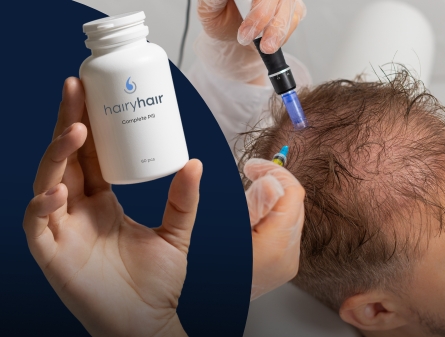
Hair pills fight shedding, promote regrowth, and support hair health. They provide a practical approach to hair loss as a once-a-day pill that comprehensively addresses a range of hair loss issues through a powerful combination of ingredients. They promote nutrient delivery to hair follicles, act as a DHT blocker, and prevent inflammation on the scalp. PRP is a minimally invasive hair growth treatment.
Platelet-rich plasma (PRP) treatment involves taking blood from the patient and isolating the nutrient-rich plasma from it through a centrifuge before injecting it into the scalp in thinning areas. This can help to encourage hair growth and healing while lengthening the growth phase of the hair cycle.
Hair pills are prescription-based but can be taken at home without supervision. PRP injections must be done in a clinic by trained professionals with specialised equipment. Take a look at the comparison table below to see if hair pills or PRP injections are the right fit for you.


- Hair pills reduce DHT levels, widen blood vessels in the scalp, and prevent inflammation.
- Taken daily and widely prescribed for the treatment of hair loss.
- Most suited for early to moderate hair thinning and prevention.
- Convenience through self-administration.
- Requires long-term commitment and consistent use.
- PRP is a minimally invasive procedure that uses the patient’s blood to promote hair growth
- Requires several clinic visits and ongoing maintenance sessions to maintain results.
- Best suited for early to moderate hair thinning.
- Offers natural and gradual improvements without relying on medication.
- Cannot be done at home, limiting convenience.
- Hair pills are offered at a 3-month supply to start and then on a monthly basis.
- Medication provides a more cost-effective option for ongoing hair loss treatment when taken consistently.
- PRP has a higher initial cost per session and requires multiple treatments as well as ongoing maintenance.
- PRP has a much higher entry point price-wise, particularly for those who are seeking a long-term treatment.
- Hair pills are taken once daily and become effective within 3-6 months.
- More convenient with time commitment, although missed doses can reduce its effectiveness.
- PRP sessions last 30-60 minutes and are spaced apart monthly, followed by quarterly maintenance sessions.
- Requires clinic appointments and consistent scheduling to maintain visible results.
- Involves drawing blood, extracting platelet-rich plasma, and injecting it into balding areas to promote follicle healing and regeneration.
- PRP doesn’t rely on hormonal changes but enhances existing follicle health.
- Hair pills block DHT production, promote nutrient delivery, and prevent inflammation.
- Acts systemically rather than targeting the scalp directly, which can have broader hormonal effects.
- Hair pills are tolerated well by most users, but can result in irritation or systemic effects.
- Adverse reactions can be combated by adjusting ingredients to maintain the benefit.
- PRP is safe and has few side effects, but since it involves drawing blood and medical equipment, there is a risk of infection if improperly administered.
- Doesn’t alter hormones but may appeal to those who don’t want to make systemic changes.
- Hair pills are easy to use since they are only a daily oral intake.
- Doesn’t involve procedures, making it more convenient for those looking for a low-maintenance option that can be self-administered.
- PRP involves several clinic visits and may not be suitable for those with limited time or access to clinics.
- Ongoing treatment requires greater scheduling and commitment.
- Hair pills are widely available online through subscription services but require a prescription.
- More accessible for those who can’t access a clinic in person.
- Available in specialist dermatology and aesthetic clinics, and may be limited by location and cost.
- Requires access to trained professionals and medical equipment.
- Hair pills can provide sustained results with continuous use, but may cause hair thinning again if discontinued.
- Depends on uninterrupted hormonal suppression and chemical change for long-term viability.
- PRP results can be maintained with regular treatments and typically fade if sessions are stopped.
- Outcome relies more on ongoing clinic attendance than daily intake.
- Hair pills are suitable as a primary monotherapy since they address various hair loss issues.
- May be paired with supplementary treatments like hair loss shampoos or vitamins to support hair health.
- PRP is typically paired with microneedling or topical treatments like minoxidil or combined with oral meds like finasteride.
- Has a direct impact on scalp health and works well within a multi-treatment schedule.
- Hair pills appeal to those who want a consistent and straightforward daily treatment.
- Works with busy schedules and people who don’t want to disrupt their routine with clinical visits.
- PRP appeals to those who want a drug-free solution that uses the body’s natural healing properties.
- The use of needles may not be compatible with some users.
- Benefits hair by reducing DHT, which may impact other hormonal functions related to benign prostate.
- Doesn’t directly enhance the follicle strength of scalp health through external treatments.
- PRP can promote regrowth, increase scalp circulation, and reduce inflammation without changing hormonal levels.
- Provides scalp-specific advantages to promote regrowth.
- Hair pills can have a lower environmental impact due to compact packaging and home use.
- Doesn’t involve creating clinical waste or repeat transport emissions.
- PRP treatments generate clinical waste from disposable syringes and frequent sessions.
- Contribute to a larger environmental footprint due to material use and travel.
Shop our hair solutions
We are committed to providing affordable hair regeneration services for people all over Australia. Our formula can help you regain your confidence.
Shop Now

Comparison Summary: Hair Growth Pills vs PRP Treatment
Hair loss pills may be a better choice if you’re looking for a treatment that uses ingredients backed by research over decades. Pills for hair loss are meant to be used as a long-term solution against hair loss, with results progressing after 3 months, 6 months, and 1 year.
PRP therapy may be better if you seek short-term results that require less maintenance than hair pills. Results can be seen sometimes after just a month, but typically, significant improvements in hair density are noticed after 3 months.
PRP treatments are done once a month for 3-6 months initially, followed by maintenance sessions every 3 or 4 months after that. The procedure can’t be done at home since it requires a licensed and skilled medical professional to administer the treatment.
Hair pills can be a better choice if you’re looking for a treatment that can easily incorporate into your life, that can be prescribed online and delivered right to your door through subscription services.
User Guidance
PRP treatments are usually more expensive than getting regular hair pills as part of a prescription. However, they could be more cost-effective in the long run since sessions are reduced over time to maintain their effect.
While the initial cost of PRP injections can be steep, subsequent maintenance sessions could spread out the cost, and clinics sometimes offer package deals for a certain number of sessions. Users do not report many potential side effects, but they can cause headaches, redness, swelling, and tenderness.
Hair pills can have systemic side effects in a small number of users, but this can be countered by adjusting the dosage. Ingredients can be changed depending on the reaction to them to help minimise any adverse reactions while still maintaining the benefit of the treatment.
Take Our Hair Loss Quiz to See Which Treatment Suits You?
Take A Hair Quiz

Frequently Asked Questions
Hair growth pills are oral supplements, often containing a blend of vitamins, minerals, and active ingredients designed to support hair health and regrowth from within. PRP (Platelet-Rich Plasma) is a medical procedure that uses your own blood, processed to concentrate platelets, which are then injected into the scalp to stimulate hair follicles and promote regrowth.
PRP generally has stronger clinical evidence for increasing hair density and thickness, especially in cases of pattern hair loss. Hair growth pills can help improve hair quality, particularly if they contain active ingredients, but are usually less effective for significant regrowth compared to PRP.
PRP typically shows visible improvements in hair density and thickness within three to six months after a series of sessions. Hair growth pills may take a similar timeframe to improve hair quality, but results are often more modest unless the pills contain strong actives or address a nutritional deficiency.
Hair growth pills are taken daily at home and may require a prescription depending on their formulation. PRP involves a clinic visit where blood is drawn, processed, and then injected into the scalp, usually over several sessions spaced weeks apart.
Hair growth pills are generally safe but can cause mild digestive upset or allergic reactions depending on the ingredients. PRP is considered very safe as it uses your own blood, but may cause temporary scalp pain, redness, or swelling at injection sites.
Hair growth pills are highly convenient, requiring only a daily dose. PRP is less convenient, as it requires clinic visits, blood draws, and injections, making it more time-consuming and less suited to those seeking a simple routine.
PRP results can last several months to a year, with maintenance sessions recommended for sustained benefits. Hair growth pills require ongoing use, and any improvements may diminish if supplementation stops.
PRP is best for those with pattern hair loss or thinning who want a clinically supported, non-surgical option. Hair growth pills may benefit people with mild thinning, nutritional deficiencies, or those looking for a non-invasive, easy-to-use supplement.
PRP is a higher-cost treatment due to the need for medical procedures and multiple sessions. Hair growth pills are typically more affordable and purchased as a regular supplement, but prices vary by brand and formulation.
Yes, many people combine both treatments to support hair health from different angles. Taking supplements alongside PRP may help optimise results, but always consult your healthcare provider for personalised advice.
Other Comparisons
See All
Hair Pills vs Hair Gummies

Hair Pills vs Hair Loss Shampoo

Hair Pills vs Hair Vitamins
PRP vs Hair Loss Shampoo
PRP vs Hair Vitamins