Call Us : 1300 800 564
Hair Pills vs Minoxidil


Hair Pills


Minoxidil

Hair pills tackle hair thinning, encourage regrowth, and boost hair health. As a daily treatment, it only requires a single oral pill. It offers a practical treatment that contains a comprehensive combination of ingredients. It works as a vasodilator, DHT blocker, anti-inflammatory, and nutrient booster. Minoxidil functions just as a vasodilator.
Minoxidil can provide thicker and healthier hair growth. While minoxidil is typically a topical treatment, hair pills are an oral solution. Hair pills work to tackle a range of issues simultaneously to give you the best chance at fighting hair loss.
Minoxidil can promote hair density and has been shown to improve hair growth in patients with male pattern baldness. Take a look at the comparison table below to see which treatment is best for you.


- Hair pills have a range of ingredients that block DHT, prevent inflammation, and improve nutrient delivery.
- Hair pills work internally to stimulate change in your hair follicles
- Hair pills have to be taken daily to be effective.
- Appeals to users who want a non-intrusive daily oral solution to tackle hair loss.
- Hair pills can cause minimal side effects, but ingredients can be adjusted to curb this.
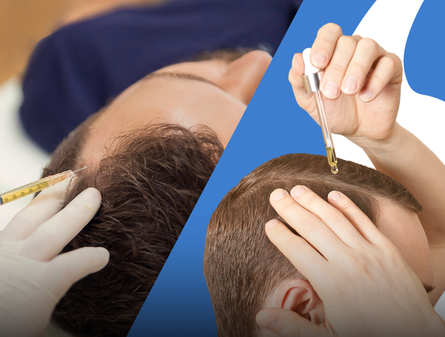
- Minoxidil is a topical treatment applied directly to the scalp to encourage hair follicles to extend the growth phase.
- Minoxidil is widely used and can be utilised in treating male and female pattern baldness.
- It is applied once or twice a day.
- Minoxidil is easily acquired as an over-the-counter treatment.
- It is often used as a primary treatment for hair loss.
- Hair pills are often offered at an initial 3-month supply before becoming a monthly subscription.
- It may cost more than minoxidil, but it contains more ingredients to tackle hair loss.
- Minoxidil is an affordable treatment sold online and in stores under various brands.
- Compared to hair pills, it presents a lower upfront cost but may not be as effective over time.
- Hair pills are meant to be used daily to achieve and hold onto results.
- Unlike minoxidil, it doesn’t need to be taken as frequently.
- Minoxidil has to be applied once or twice a day on a long-term basis.
- Unlike hair pills, application frequency may change over time depending on hair growth.
- Hair pills decrease DHT levels, promote nutrient flow to hair follicles, and prevent inflammation.
- In contrast to minoxidil, it makes systemic changes in multiple areas of the body.
- Minoxidil acts as a vasodilator to widen blood vessels on the scalp so more oxygen and nutrients reach the hair follicles.
- In contrast to hair pills, the treatment method is done topically to create change through external application.
- Hair pills offer a convenient daily oral treatment that is compatible with busy schedules.
- Compared to minoxidil, it doesn’t take up as much time and doesn’t require physical application.
- Minoxidil requires once or twice daily application through a serum or foam, which may be time-consuming for some.
- Compared to hair pills, it is a more involved treatment with a hands-on approach.
- Hair pills can be acquired online through subscription services, but often require a prescription.
- Compared to minoxidil, you’ll need to talk to a doctor, but receiving monthly deliveries may be less time-consuming.
- Minoxidil is available over the counter in stores without a prescription.
- Compared to hair pills, they are more readily available but may need to be purchased in person frequently.
- Hair pills can offer sustained results through long-term and continuous treatment.
- Unlike minoxidil, it doesn’t require physical application to see a change.
- Minoxidil can improve hair growth and density over time through persistent application.
- Compared to hair pills, minoxidil may not prevent future shedding because of its modality.
- Hair pills are made up of a range of ingredients, which means it’s less likely you’ll need to combine the treatment with other solutions.
- Compared to minoxidil, you may need to use support treatments like hair products or vitamins to boost your hair.
- Minoxidil may need to be paired with other treatments that target different hair loss causes, such as finasteride or PRP injections.
- Compared to hair pills, it can be used as the base of a topical treatment plan that can be paired with other external solutions.
- Hair pills appeal to people who want a convenient solution that doesn’t interfere with their daily lives.
- Compared to minoxidil, it may offer more peace of mind since it simultaneously addresses various hair loss concerns.
- Minoxidil appeals to users who want an accessible treatment with a practical application.
- Compared to hair pills, seeing change through external treatment over internal chemical shifts may be more satisfying.
- Hair pills may offer health benefits aside from hair loss, such as the possibility of reducing the risk of prostate cancer.
- Compared to minoxidil, it works internally rather than creating potential change through external action.
- Minoxidil works to encourage follicles to extend the growth cycle but doesn’t directly impact scalp health or blood flow.
- Compared to hair pills, the effect is more targeted for a singular hair growth factor.
- Hair pills can cause possible plastic waste due to packaging and production.
- Compared to minoxidil, it is less likely to cause issues with water runoff since it is in pill form.
- Minoxidil creates more sustained plastic waste through bottles and applicators, along with packaging.
- In contrast to hair pills, it can have a higher potential to cause environmental damage.
Shop our hair solutions
We are committed to providing affordable hair regeneration services for people all over Australia. Our formula can help you regain your confidence.
Shop Now

Comparison Summary: Hair Pill vs Microneedling For Hair Loss
Hair pills provide a comprehensive approach to hair loss. They use a combination of effective ingredients to create internal change. The ingredients have been well researched over decades for their use as a long-term treatment.
Microneedling before and after results have been shown to be applicable for a range of hair loss conditions, from pattern hair loss treatment to alopecia areata (immune system hair loss). However, microneedling sessions can be expensive over time, as 1-2 treatments per week are needed for the first 3-4 months, followed by maintenance sessions if done in a clinic.
Hair pills may offer a cheaper solution in the long term that uses natural and pharmacological ingredients to tackle hair loss from different causes. Lower microneedling costs are available with the purchase of at-home devices. Still, they will not be as effective as clinical-grade devices and present a risk of infection if they aren’t properly cleaned and disinfected or if too much pressure is applied during application.
User Guidance
Hair pills can lead to an adverse reaction in some users, but there is a low chance of this happening. Hair pills can be adjusted to suit your needs to tackle any potential negative side effects while offering treatment benefits.
Microneedling may not be as effective when used alone, whereas hair pills can work well as a primary treatment. Although microneedling can have positive results as a monotherapy, it works best in combination with other topicals like minoxidil spray or PRP injections.
Hair pills can be accessed through an online subscription but require a consultation due to the ingredients used. Microneedling devices can be bought for at-home use, but some research may be necessary since many devices available aren’t approved for use by regulatory bodies like the TGA, and microneedling aftercare needs to be observed.
Take Our Hair Loss Quiz to See Which Treatment Suits You?
Take A Hair Quiz

Frequently Asked Questions
Hair pills are oral supplements that may contain a blend of nutrients and active ingredients to support hair growth from within. Minoxidil is a topical or oral medication that works by widening blood vessels in the scalp, helping to stimulate hair follicles and encourage new growth.
Hair pills may help those with mild thinning or nutritional deficiencies, while minoxidil is suitable for people experiencing pattern hair loss or general thinning, as it has a well-established track record for promoting regrowth.
Hair pills are taken once a day, usually with water. Minoxidil is applied directly to the scalp once or twice a day, or taken as a tablet if prescribed, and requires consistent application for best results.
Hair pills are generally well tolerated, but may cause mild digestive discomfort or allergic reactions in some people. Minoxidil can cause scalp irritation, dryness, or unwanted hair growth on adjacent areas; oral minoxidil may have additional risks and should be monitored by a doctor.
Minoxidil users may notice reduced shedding and early regrowth in three to six months, with continued improvement over a year. Hair pills may take a similar amount of time to improve hair quality, but visible regrowth is less likely unless the underlying cause is nutritional.
Both treatments require ongoing use to maintain results. Discontinuing minoxidil often leads to renewed hair loss, while stopping hair pills may cause any benefits to gradually fade.
Hair pills are quick and easy to take, making them convenient for most routines. Minoxidil requires regular application and drying time, which can be more demanding for some users.
Yes, many people use both treatments together to support hair health from different angles. Combining a supplement with a topical or oral medication may optimise results, but it is best to consult your healthcare provider before starting both.
Hair pills are purchased as a regular supplement, while minoxidil is available over the counter or by prescription, with costs varying by brand and formulation. Both are generally affordable compared to surgical options.
Consider your hair loss type, lifestyle, medical history, and preference for oral or topical treatments. Consulting a healthcare professional can help you select the most suitable approach for your needs.
Other Comparisons
See All
PRP Treatment vs PEMF Treatment
PRP vs Laser Therapy